_(1).png)

Handover Meeting from Bundulai to Makari, Port Loko Feeder Road Project
- Muhammad Kamran
- Nov 28, 2025
- 3 min read
Updated: Dec 9, 2025
Connecting Communities Through Better Roads: Bundulai to Makari Feeder Road Handover in Port Loko
The European Union (EU) funded Opportunity Salone Feeder Road Project plays a vital role in strengthening three key agricultural value chains — cassava, vegetables, and palm oil. For the farmers and traders who rely on these sectors, feeder roads are lifelines, ensuring their produce reaches markets safely and efficiently.
To keep these connections strong, the ILO supports the rehabilitation of rural feeder roads across Bo, Kenema, Bombali, and Port Loko Districts. In total, twenty SME contractors were competitively selected — five in each district — and all have undergone labour-based training provided by the ILO to equip them with the technical and safety skills needed for effective road works and long-term maintenance.

The Start of a Journey Toward Greater Connectivity
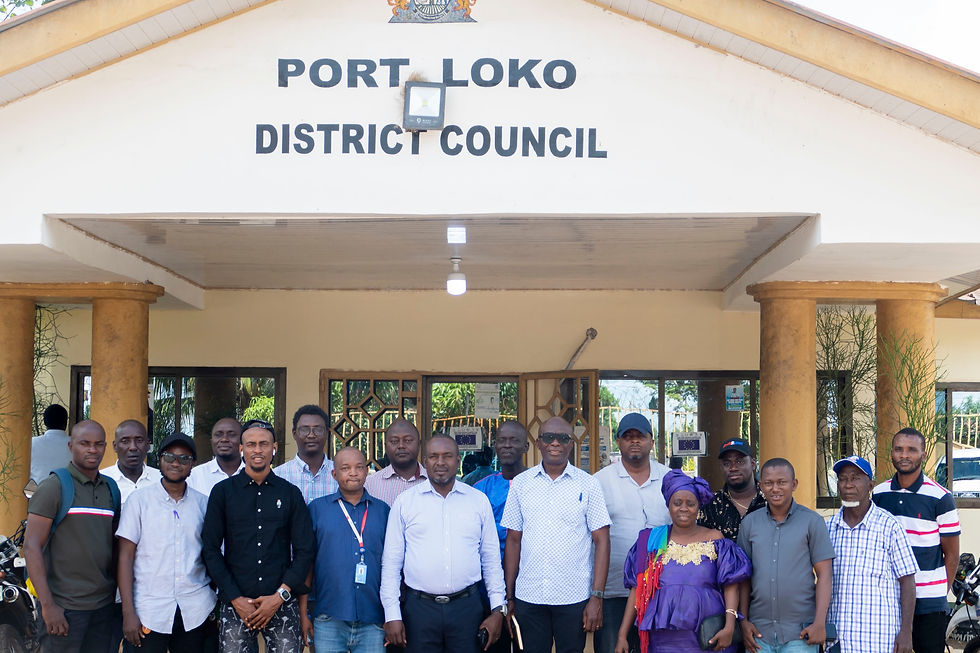
On 22 September 2025, the International Labour Organization (ILO), in collaboration with the Port Loko District Council, officially launched the Bundulai to Makari feeder road rehabilitation project. The handover and stakeholder meeting, held at the District Council office, marked the start of a 14.3- kilometre transformation that will connect farming communities to markets and essential services.
This project is part of the ILO’s broader effort to strengthen rural infrastructure under the Opportunity Salone initiative, ensuring that farmers and traders can move their produce safely and efficiently across the district.

Meet the Builders: Local SMEs Leading the Way
Five SME contractors have been entrusted with rehabilitating different sections of the Bundulai–Makari road — a partnership that not only builds infrastructure but also creates jobs and strengthens local enterprise capacity:
Samjit Logistics and Engineering Company, managed by Fatmata Massaquoi – 3.4 km
H&H Engineering, managed by Muniru Kamara – 3.4 km
Dawood Transport SL Limited, managed by Sallieu Conteh – 2.5 km
Obbai E Porto Investment, managed by Ibrahim S. Fofannah – 3.2 km
Sinnah Bassco Bah Construction Company, managed by Sinnah Bassco Bah – 1.8 km
Overseeing the process were key members of the Technical Project Advisory Committee (TPAC), including Sheka Sannoh (Co-Chairman), Ahmed Nanoh, Samuel J. Maculey (Senior Engineer, SLRA Headquarters, Freetown), and Abdul Nasar Fofannah (Senior District Engineer, SLRA Port Loko). The ILO team, represented by Austin Nguku, Technical Officer, EIIP and Amadu Sajor Jalloh, Feeder Roads Engineer, reaffirmed the organization’s commitment to quality, inclusivity, and sustainability in every phase of the project.

A Shared Commitment to Progress
The meeting opened with prayers and welcoming remarks from Arthur Allieu, Chief Administrator of the Port Loko District Council, who highlighted the importance of collaboration and local ownership. Participants discussed project timelines, contractor roles, and the long- term impact of the road’s rehabilitation — from easing transport costs and improving market access to enhancing education and healthcare delivery.

Driving Growth, Connecting Lives
This handover marks the beginning of a new chapter for the Bundulai to Makari communities. By providing a reliable and safe feeder road, the project lays the foundation for economic growth, improved social services, and sustainable livelihoods.
The collaboration between the EU, ILO, the Port Loko District Council, SME contractors, and TPAC demonstrates how well-planned infrastructure interventions can transform rural communities, connecting people to markets, education, healthcare, and opportunities for progress and hope.
Key Figures
Road length: 14.3 km
SMEs engaged: 5 contractors
Employment: Estimated 230 local workers
Construction duration: 5 months (1st October 2025 – 28th February 2026)
Value chains supported: Cassava, vegetables, and palm oi


Comments